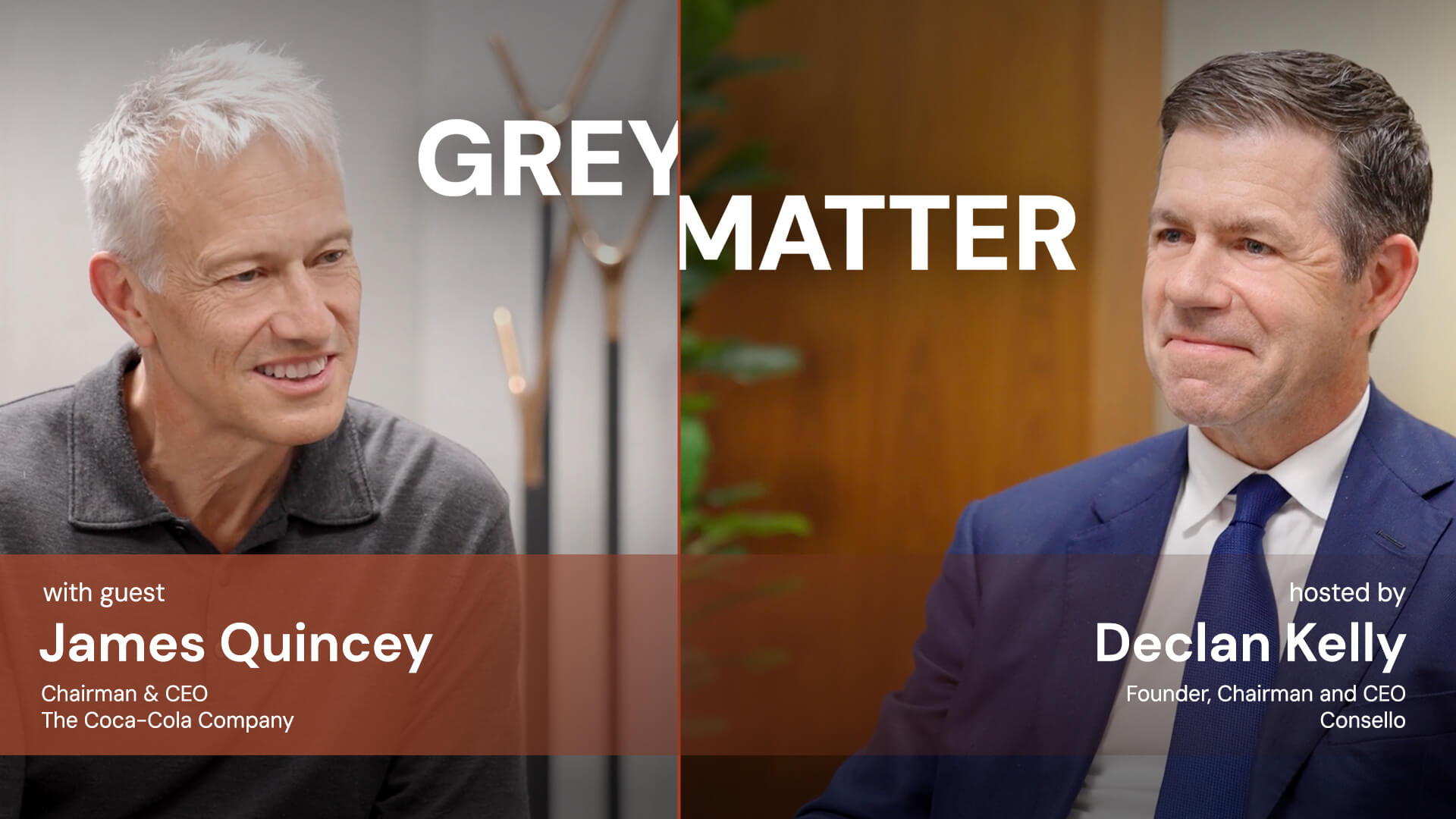
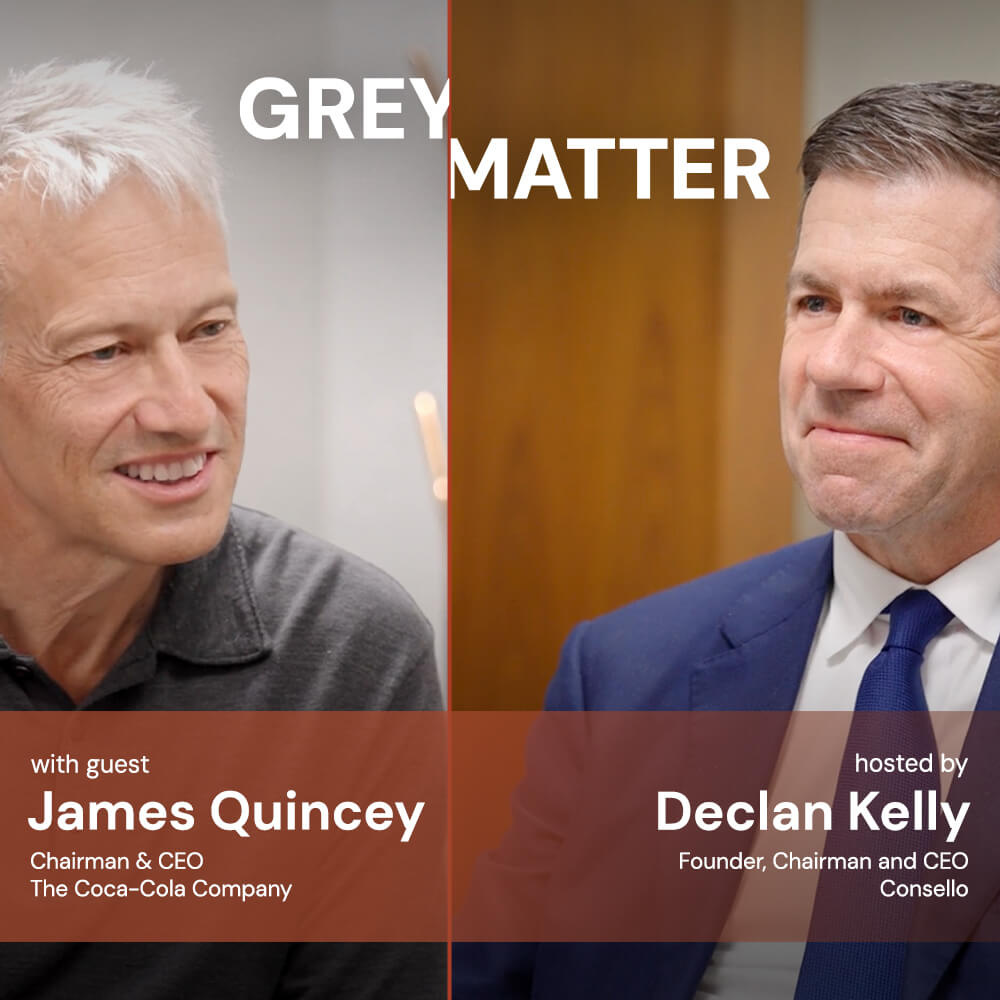
When James Quincey became Chairman and CEO of The Coca-Cola Company in 2017, the appointment represented a significant break from history. At 52, he was younger than typical successors in a company that had historically favored leaders later in their careers. His background as an engineer brought a different lens to a role that had been defined by marketing instinct and brand stewardship for nearly 140 years.
The transition involved the usual corporate rituals. Town halls, press releases, carefully choreographed messaging about continuity and vision. If someone had surveyed employees the week after the announcement asking what they remembered most, the answer would have been he wore jeans, and it wasn’t a Friday.
“Everything communicates,” Quincey said, describing how he thinks about leadership decisions. “I think a lot of managers make the mistake of thinking that what’s on the PowerPoint is 90 percent of the message.”
The clothing choice signaled that change was coming, that formality would give way to a more direct perspective on what needed to be done. The symbology cut through what would have otherwise become corporate language about transformation.
“It was all part of a strategy to communicate we’re going to change and this is the direction we’re going in,” he said.
What followed over the next six years tested whether that symbolic gesture could translate into the harder work of actually changing how a global institution operates, deciding what needed to evolve, what needed to be protected, and how to move forward while preserving what had been built over more than a century.
Everything Communicates
The challenge Quincey faced centered on how to make changes credible when a century of organizational momentum pulled toward continuity. Leaders often assume the strategy presentation carries the message, that what’s written in the deck or said in the town hall defines what people understand about where the company is heading.
“Imagine if you were scoring yourself on a change management process,” Quincey said. “Every time you do something that’s consistent with the change you’re espousing, you get one point. And every time you do something that’s not consistent with what you’re espousing, you get minus ten. How would you do?”
The asymmetry matters because dissonant actions are disproportionately weighted in how people experience leadership. A leader can communicate the right priorities in prepared remarks, outline the transformation in carefully constructed presentations, and still undermine all of it through a single decision that contradicts the stated direction. People notice what you do more than what you say, and they notice what doesn’t align far more than what does.
The jeans on a non-Friday became the most memorable element of Quincey’s start because they represented something tangible in a sea of corporate messaging about change. The gesture was small, but it communicated directly that formality would give way to directness, that hierarchy would matter less than ideas, that the culture he intended to build would look different than the one that preceded it.
“You have to be ruthlessly coherent with what you’re asking for,” he said.
For leaders managing through periods when established patterns need to shift, the distinction between articulating a vision and embodying it through every decision determines whether the organization experiences the transformation as real or as another wave of messaging that will eventually pass.
Bold Decisions with Imperfect Information
People often tell Quincey they would love to be a CEO, attracted by the perception that the role involves making exciting decisions and leading high-profile initiatives. His response challenges that assumption directly.
“Trust me. None of the cool stuff comes to the top,” he said. “Everything that’s nice and easy has been done or decided by someone else. The stuff that ends up to you, the difficult decisions, imperfect information, uncertain set of choices, unknowns about the future world. No one’s going to make those hard decisions for you. And that’s what the leadership is ultimately about.”
The observation captures something fundamental about how decision-making works at scale. Organizations filter problems upward based on complexity and consequence. Issues that can be resolved with existing frameworks, clear data, and established precedent get handled at lower levels by people with the authority and information to act. What reaches executive leadership represents the residual, situations where the path forward isn’t obvious, where multiple constituencies have conflicting interests, where the information available doesn’t point cleanly toward a single answer.
Those decisions require a different kind of judgment than analytical precision alone can provide. The engineer’s training helps, the probabilistic thinking matters, but at some point leadership becomes about having the courage to commit to a direction when certainty isn’t available and when waiting for perfect information means the moment for action passes.
At The Coca-Cola Company, a company with 140 years of history and global reach, the temptation to defer difficult choices is particularly strong because continuity has always carried weight and because changing course affects so many stakeholders across the system. Quincey’s tenure became defined by the willingness to make those decisions anyway, to act when analysis could only take him so far and when further delay would itself become a choice with consequences.
When Everyone Knows But No One Acts
The Coca-Cola system had 30 million customer outlets worldwide and 16 million pieces of equipment in the field. Each cooler had limited shelf space, and every product that occupies that space but doesn’t sell represents an opportunity cost, preventing something that would actually move from reaching consumers and generating revenue for everyone in the system.
By the time Quincey became CEO, the company’s portfolio included more than 250 brands that had limited growth potential and were occupying space that could be used for products with stronger consumer demand.
Many in the organization understood they needed to be removed because the math was straightforward, but the emotional attachment to individual brands created resistance to actually doing it. Someone had worked on these products, invested time in developing them, believed in their potential at some point.
Quincey wanted to call them zombies. There was significant pushback because the label felt mean, like he was denigrating products people had worked on. He insisted on it anyway.
“I was evoking a simple idea for people on if this thing is tiny and it’s never going to grow again, it’s a zombie and it needs to be put out of its misery,” he said. “Simply calling it a zombie mobilized the system around, ah, now we know what we’re looking for. Let’s take them all out.”
The decision benefited the entire system. Consumers could find products they wanted to buy, retailers could stock items that moved, bottlers could operate more efficiently. The case for removing these brands was clear to everyone involved, but acting on it required someone willing to make the call.
“The CEO, one of the number one things they have to do, is make the courageous decisions that everyone knows are true, but no one’s going to make it for you,” he said.
The Future Belongs to the Discontented
Robert Woodruff served as CEO of The Coca-Cola Company for decades, beginning in the early 1920s and remaining involved in the business into the 1970s. On the company’s 50th anniversary, nearly 90 years ago, he wrote a speech. One and a half pages, typewritten. He had not given it a title when he drafted it, but later added one in pencil at the top of the page.
The Future Belongs to the Discontented.
“That idea that no matter what’s happened today or in the past, whether you’ve had miserable performance, okay performance, or you’ve knocked it out of the park, that doesn’t guarantee you the future,” Quincey said. “None of them do. And you’ve got to be discontented if you want to be great in the future.”
The concept resonated with Quincey because it addressed something fundamental about how organizations lose momentum. Past success creates complacency and the assumption that what worked before will continue working. Woodruff’s insight was that the relationship between past and future performance is weaker than people assume, and that sustained excellence requires maintaining hunger regardless of results.
Quincey values ideas like this because they organize thinking without requiring extensive explanation. “I love the ideas that organize everything around you,” he said. “Those simple ideas, if you can find the simple idea, it organizes everything almost on its own because it’s so clear for people what to do.”
For a company stewarding brands that have endured for more than a century, the temptation to rely on heritage and established strength is constant. Woodruff’s message, written when The Coca-Cola Company was 50 years old, suggests that longevity depends on refusing to be satisfied with what’s already been built. The future belongs to those discontented with the present, regardless of how successful the present appears to be.
What Lies Ahead
Quincey’s tenure as CEO became defined by applying engineering discipline to questions that typically get answered through instinct or precedent. How do you steward a brand that has endured for nearly 140 years through periods when consumer behavior, technology, and expectations are changing faster than the operating models built to serve them? The answer emerged through a pattern of decisions that prioritized ruthless coherence over comfort.
Everything had to communicate the same message, with dissonant actions weighted disproportionately in how people experienced leadership. Hard decisions with imperfect information couldn’t be deferred simply because certainty wasn’t available. Changes that everyone knew were necessary but no one would act on required someone willing to make them anyway. And past performance, regardless of how strong, provided no guarantee about the future without sustained discontent pushing the organization forward.
What Quincey demonstrated was that stewarding an iconic institution through change depends less on protecting every element of how things have always been done and more on knowing what must be preserved versus what must evolve. The Coca-Cola Company brand remained unchanged. The formula, the color, the script endured as they had for more than a century. But the system around it, the structure supporting it, the portfolio surrounding it all had to adapt to remain fit for purpose.