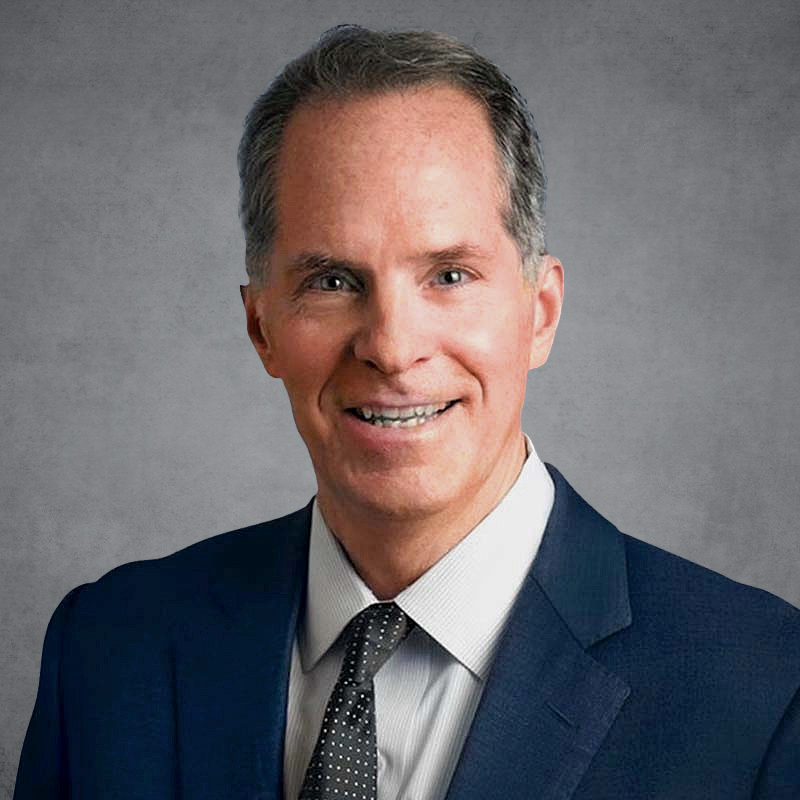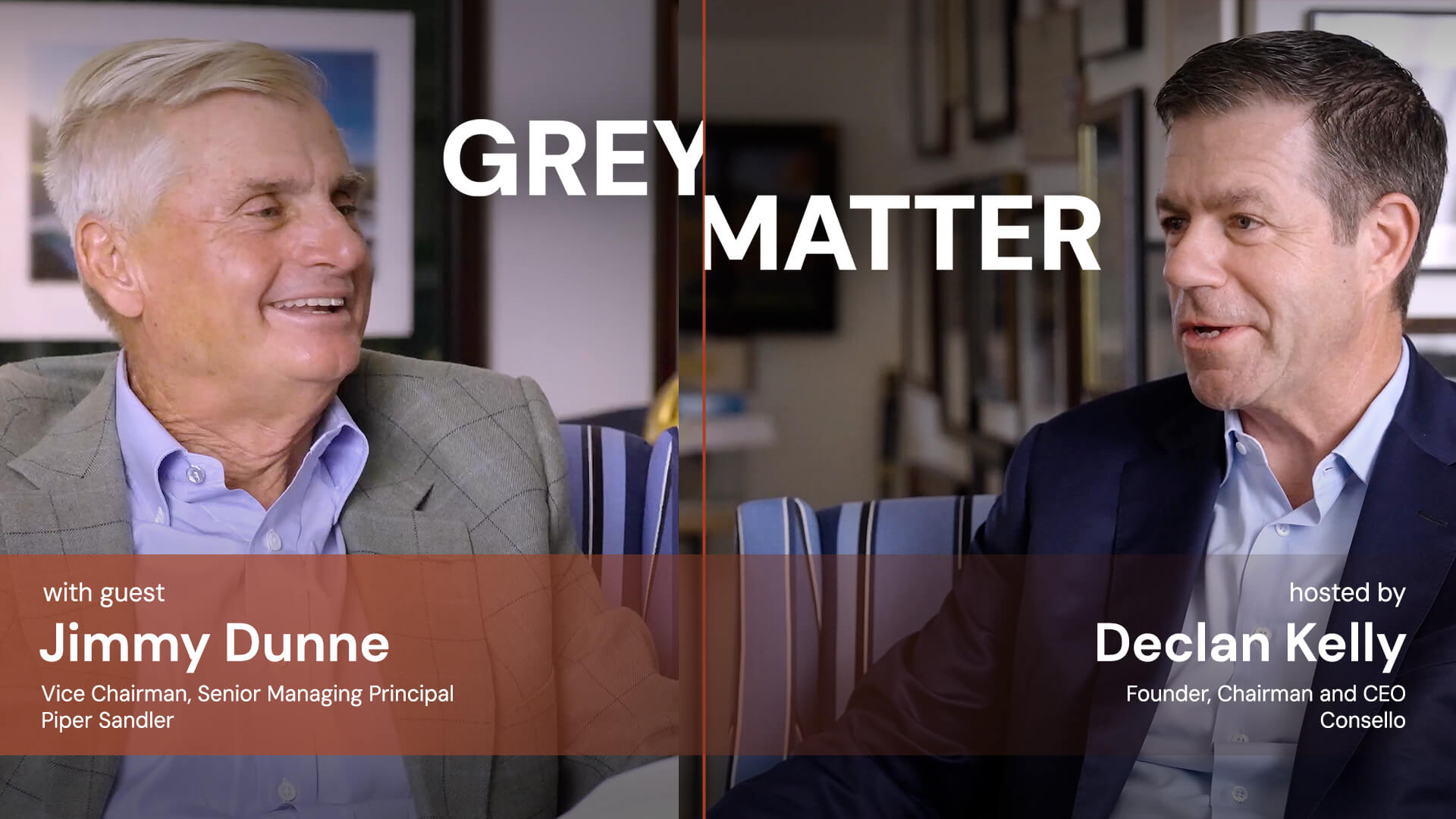
For four decades, Jimmy Dunne has operated in a multitude of environments where the pressure would be perceived by many as insurmountable.
As a co-founder at Sandler O’Neill, now Piper Sandler, he built one of Wall Street’s most respected boutique investment banks. After the terrorist attacks on 9/11 killed 66 of his colleagues, including the firm’s leadership, he led the effort to rebuild while committing to pay for the college education of every child who lost a parent in the attacks. Years later he served on the board of the PGA Tour during the most contentious period in professional golf’s history, eventually testifying before Congress about his role in unification discussions with LIV Golf.
When Jimmy addresses Yale Business School students each year, he tells them that in a straight academic exam, he would likely finish last in the class. “However, if we change the environment,” he tells them, “if we made it like it was so much pressure that a normal human couldn’t even breathe, that the tension would be out of control and it would be like where you could actually see people break down, I would finish first.”
Whether this assessment is accurate matters less than that he believes it completely, and that belief shapes how he approaches situations where difficulty compounds. He views increasing pressure as increasing the advantage for him personally. This explains why he was, in his assessment, “unusually suited for 9/11.” The organization faced conditions that exceeded any plausible scenario and most people’s capabilities would diminish under these conditions. Jimmy’s capabilities inherently expanded because the very factors that overwhelmed others created the environment where his particular constellation of attributes functioned optimally.
What transpired was a life and career defined by rising to moments that demanded everything and fighting for those who had depended on or invested in him.
Crisis as Clarity
Jimmy’s public profile has become indelibly linked to September 11 after Sandler O’Neill lost two-thirds of its New York office in the attacks, including many of Jimmy’s closest partners and friends. In the period that followed, he assumed responsibility for stabilizing the firm while also supporting the families of those who were lost, including a commitment to fund the education of every child left behind. The firm’s recovery took place under sustained emotional strain and national observation, with little separation between personal loss and professional obligation.
Jimmy’s response was grounded in a sense of obligation arising from the cumulative investments others had made in him.
“I really felt like I had an obligation to everybody that stood by me,” he said. “My mother. My father. Joe Milen, the guy I used to caddy for. So many people. I felt this is the time I had to show up for them.”
However, he describes the period as one of uncertainty about survival but absolute clarity about behavior. After telling his wife they would likely lose everything, her acceptance eliminated a source of friction that might otherwise have been a distraction from how to move forward.
“I didn’t know if we were going to make it,” he says, “but I knew what I had to do.”
Weeks after the attack, working in the office at 4:30 a.m., Jimmy felt something in his chest that made him stop for a moment and wonder if his heart might give out. He noticed it, considered the possibility that he might die trying, and kept working. The obligation was still there, and the work hadn’t changed.
For leaders managing through criseis or existential threats, the dynamic reveals how obligation can function as clarity when rational calculation produces paralysis and when certainty about outcomes becomes indistinguishable.
Refined Desperation Without Toxicity
Most organizations struggle to create the level of intensity required for exceptional performance without generating the toxicity that makes that intensity unsustainable.
In contrast, the concept Jimmy articulates as “refined desperation” – —leadership without toxicity – —emerged from a principle his parents enforced: you look neither up nor down at people, only eye to eye.
Chris Quackenbush, Jimmy’s friend who scored 1550 on the SATs and was bound for law school, noticed their co-workers at a bar job preferred Jimmy despite Chris treating them with more explicit kindness. Quackenbush asked why and Jimmy explained that Quackenbush’s kindness carried the undertone of someone passing through, someone for whom this job was temporary on the way to superior circumstances.
“With me, they know that they’re just getting the authentic deal,” Jimmy said. “I don’t feel like I’m that far ahead of anybody. And it’s been a great benefit when you don’t look up and you don’t look down. You just treat everybody equally.”
Jimmy is well known for creating tension deliberately, pushing people outside of their comfort zones, because he views pressure as the condition under which real capability reveals itself. A Fortune Magazine reporter following him for weeks noticed he treated people he hired with notably more difficulty than those he didn’t invest in. He would deliberately make candidates uncomfortable during interviews, creating pressure to observe how they responded when the interaction stopped being pleasant. Performance under favorable conditions told him nothing useful about how someone would operate when markets turned, when clients were angry, when the firm faced existential risk.
The approach generated loyalty rather than resentment because people understand the intensity comes from someone who views himself as operating under identical constraints. For leaders managing organizations that require sustained high performance under conditions where judgment failures carry material consequences, the distinction between refined desperation and simple toxicity may be the difference between cultures that attract exceptional talent and cultures that burn through it.
Golf as a Diagnostic Instrument
Traditional executive assessment relies on controlled environments where people have time to prepare responses and stakeholders have incentive to present curated versions of themselves. Jimmy describes golf as a laboratory where four and a half hours of observation reveal patterns that would take months to surface in controlled professional environments. The game creates conditions where performance matters, where circumstances shift unpredictably, and where people’s responses to frustration display themselves without the filtering that occurs in settings where stakes feel more obviously consequential.
“I can tell just about everything about a guy after a round of golf,” he said. “How he – —when something gets wrong, how he reacts. Level of his intensity. What’s important. When it gets uncomfortable, do you see a bad side of him?”
His own performance backs up what he’s looking for in others. The course record he set at Shinnecock still stands. Playing the back nine with the record in sight, he focused on executing each shot rather than thinking about the final score. The mental discipline required was identical to what he’d been developing since working at the caddy yard. Performing under observation, when real stakes were on the line, when staying composed meant the difference between winning and losing.
The value of any assessment tool isn’t whether it predicts performance accurately. It’s whether it creates conditions where people show you who they really are when things get difficult. The leader who stays calm through eighteen holes as drives land in the rough and putts slide past the pin reveals something you’ll never see in a polished interview.
Jimmy was building a firm that would have to perform when pressure broke most people’s judgment, so he evaluated people under similar pressure instead of giving them controlled settings where they could display their best-rehearsed answers.
Zebra or Lion
Jimmy often refers to an analogy that captures how he thinks about enduring performance.
“There are two kinds of animals in the world,” he explains. “There’s the slowest zebra and the fastest lion. And you’re either one or the other. But the point is both have to get up and run. So, it isn’t like the lion is that advantaged because if the zebra’s that much faster, he can outrun the lion. And I’ve always kind of viewed myself – —I am much more comfortable viewing myself as the underdog.”
Survival depends on daily execution regardless of accumulated credentials or past performance. Jimmy finds comfort in the underdog position because it clarifies what’s required. You get up and run. Whether you’re the lion or the zebra matters less than whether you’re willing to wake up and move every single day.
The mindset prevents complacency that comes from past success. When you view each day as requiring the same effort regardless of what you accomplished yesterday, previous wins don’t create false security. The Shinnecock course record demanded total focus shot by shot. Rebuilding after September 11 required risking everything without certainty of survival. Each situation required getting up and running regardless of circumstances and regardless of whether conditions favored you or threatened to consume you entirely.
Operating Under Scrutiny
Testifying before Congress on the PGA Tour–LIV Golf issue placed Jimmy in unfamiliar territory. He was alone at the table, facing direct questions, while the committee had full access to his emails and communications. As the start drew closer, he wondered how he had talked himself into it.
What allowed him to function under these conditions was the same clarity that had emerged throughout his career, that his intentions were transparent to himself. He knew what he’d tried to accomplish, knew his motivations aligned with attempting to unify professional golf rather than pursuing personal gain, and knew that whatever emerged from the testimony couldn’t alter those facts. The lawyers who prepared him subjected him to conditions he described as miserable, systematically identifying every vulnerability. The purpose was to create resistance to pressure through controlled exposure at intensity that exceeded what the actual testimony would produce.
After the formal testimony concluded, Senator Blumenthal approached and suggested their positions weren’t far apart. Jimmy’s response was, “Senator, I think that down deep neither of us want the game to be turned over to any other country or any other foreign body. The only difference is I’ve got a plan that could make them be a very productive participant and it could be good for everybody.”
The outcome validated what he knew, that his actions were defensible when examined against his stated intentions. The process was uncomfortable, but it created a public record at a moment when silence would have allowed speculation to persist.
When leaders face scrutiny designed to expose weakness rather than establish truth, the instinct is often to minimize exposure. Jimmy’s willingness to submit to conditions he couldn’t control, in service of creating transparency about intentions, shows that accountability under pressure can function as validation rather than risk.
What Lies Ahead
What emerges from the accumulated patterns is a person whose instincts have been shaped by exposure to extreme pressure. The caddy yard taught him to read people and keep himself in check. His parents taught him to evaluate decisions systematically and maintain relationships independently of hierarchy. His early career placed those instincts under sustained pressure, and September 11 confirmed that they held when conditions moved beyond anything most people could endure.
The harder question is whether instincts like these can be replicated at all. They aren’t assembled deliberately or acquired in pieces. They form through repeated exposure to specific conditions, over time, where pressure is real and consequences arrive quickly. You can point to elements that matter – —how attention narrows under stress, how comfort with pressure grows rather than recedes, how obligation sharpens judgment – —but those traits only take hold when they are reinforced again and again in situations that don’t allow retreat.
What Jimmy built was a particular form of readiness, the capacity to recognize when a moment demands everything you can provide and the willingness to deliver it without reservation about consequences to yourself.
The architecture remains visible in how he operates now, the intensity he brings to everything from cards to golf to business relationships, the comfort with creating tension because he trusts people to understand the underlying respect. The question isn’t whether others can develop similar instincts but whether they’re willing to accumulate the specific exposure across sufficient time under conditions where consequences are real.
Most people have the capacity.
Few have the circumstances or the constitution to sustain the required repetitions without moderating the intensity that makes the development possible.