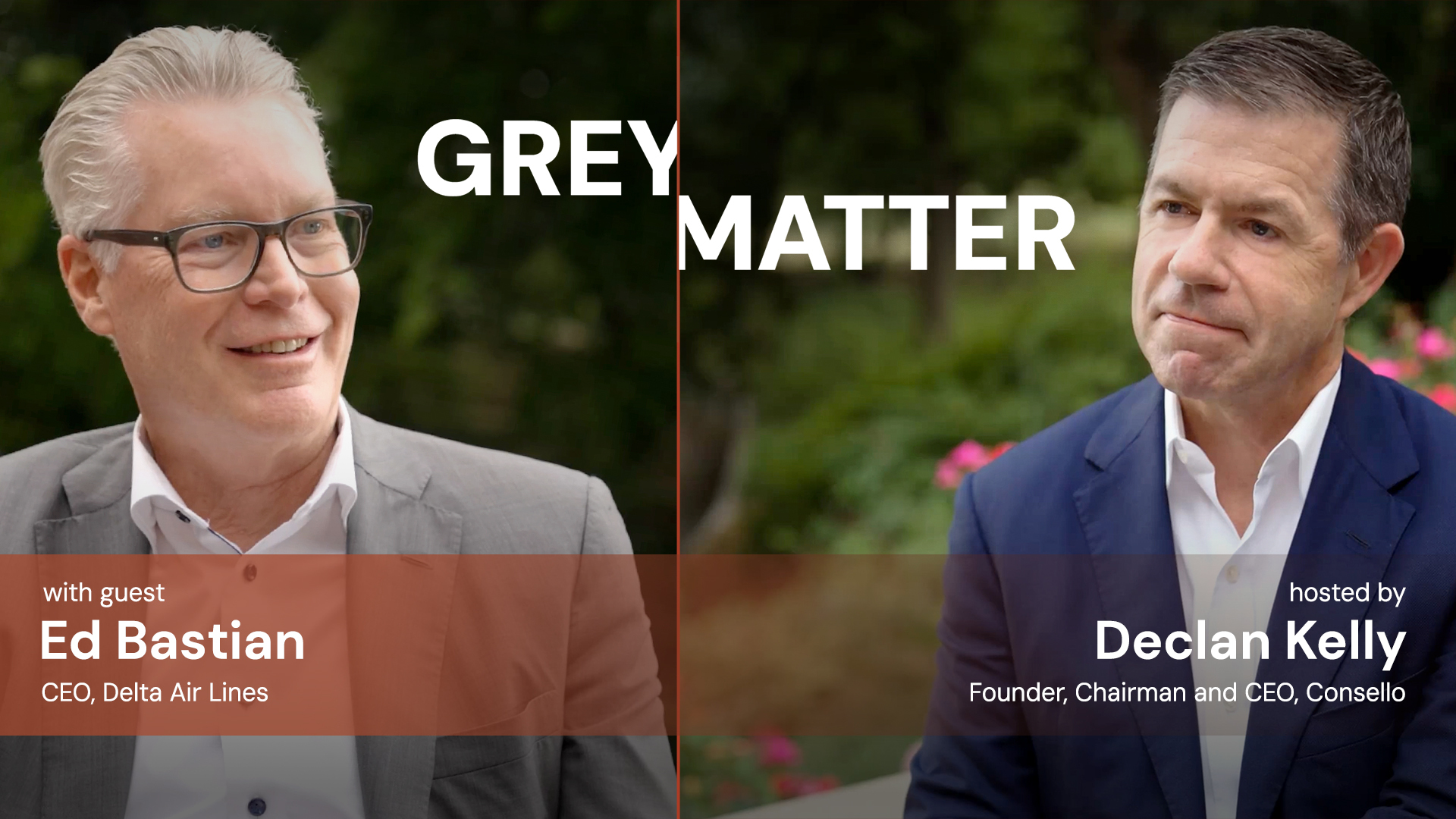
Few leaders have navigated as many high-stakes moments as Ed Bastian. I have known him for many years, including through periods that tested not only Delta Air Lines, but the assumptions leaders often carry about responsibility and resilience.
His perspective was shaped early. His mother modeled a strong sense of obligation, grounded in the belief that having the capacity to help carried a responsibility to act and take care of others.
That lesson became personal when Ed was 15, after his younger brother was diagnosed with osteosarcoma. Mornings were spent driving him to Memorial Sloan Kettering, and nights were often spent in hospital rooms alongside families facing very different outcomes.
Years later, sitting with him in Piedmont Park in Atlanta to film Grey Matter, what stood out during our conversation was not any single decision he made at Delta, but the recognition that the most consequential work had occurred long before those moments arrived.
Over time, those experiences shaped the instincts and habits that would guide him during the most important decisions of his career.
Problems Age Badly
Early in his career, Ed came to believe that delay carries its own risk and that the timing of a decision often matters as much as the decision itself.
“People are not born good decision makers,” he said. “People learn how to become good decision makers. If you make decisions early enough, before problems age into larger ones, you improve your outcomes.”
Unaddressed problems tend to compound. Waiting for complete information does not reduce risk, it often increases it. Acting early preserves flexibility, while delayed certainty can eliminate viable alternatives.
That lesson was cemented after September 11, when Ed was serving as Delta’s SVP of Finance. As the airline industry reeled, Delta’s leadership believed the company could endure without restructuring. Ed disagreed, arguing that an early bankruptcy filing was necessary to preserve options before conditions deteriorated further. When those efforts failed, he chose to leave, believing that remaining would signal support for a strategy he did not endorse.
Six months later, Delta asked him to return and lead the restructuring. With $2.5 billion in exit financing at stake, in an industry where airline bankruptcies almost always failed, Delta emerged as one of only four U.S. carriers to survive the process.
The experience reinforced a principle Ed has carried since – —problems rarely improve with time.
Questions Before Any Major Decision
Before any major decision, Ed applies a consistent set of questions. How will employees respond to the decision? Will they view it as good for them? Will it strengthen the business? Will it support long-term growth? Options that do not clear those thresholds rarely move forward.
That framework shaped Delta’s response when the Covid-19 pandemic brought global aviation to a standstill. As the industry moved quickly toward furloughs, Ed rejected that approach. Losses were inevitable, he said at the time.
“We were all going to lose a gazillion dollars no matter what we did. If you are going to lose a gazillion dollars, do it with people on your side.”
What followed was an arrangement without precedent in the industry. Roughly half of Delta’s workforce volunteered to step away from the payroll so the other half could remain employed. Participation was voluntary and not governed by seniority. Employees agreed to the arrangement with the understanding that they would continue to receive health benefits despite not working, in many cases for nearly two years.
The same reasoning informed Delta’s decision to block middle seats during the pandemic. While competitors sold every available seat, Delta left roughly one-third of its capacity empty. Analysts warned the move would cost the company billions in foregone revenue.
“Our flight attendants, our pilots, our airport workers did not want to work in a crowded environment during Covid any more than customers wanted to sit there,” Ed said.
In the near term, Delta generated more revenue per aircraft than competitors operating at full capacity. The longer-term effect became visible as demand returned. Eighteen months later, Delta faced minimal staffing disruptions, while rival carriers canceled thousands of flights amid shortages of trained crews.
For Ed, the sequence reinforced a broader lesson.
“When you do something that is the right thing to do and the good thing to do,” he said, “it is usually the smart thing to do as well.”
Building Character Before the Crisis
In early March 2020, just days before pandemic lockdowns upended daily life, Ed met with Frank Blake, then chairman of Delta’s board. Blake offered a warning that would soon prove prescient.
“This is going to be the test of your lifetime,” Blake said. “A lot of people think that is the moment where character is formed. That is not true. If you do not have character when that moment arrives, you are going to get blown away.”
As the crisis unfolded, the distinction became visible across nearly every industry. Executives who had not invested in establishing or communicating their values before the crisis struggled to establish credibility once pressure intensified. Decisions were often made defensively, with little coherence or a deeper sense of direction.
Over three decades, Ed had built a leadership profile defined by a consistent set of values, reinforced through repeated, consequential choices.
“You need to understand your values in terms of who you are personally, who you are professionally, and who your company is,” he said.
When Covid-19 hit, that accumulated trust mattered more than any single tactical decision. Moves that appeared counterintuitive to critics were possible only because credibility had already been established.
Permission cannot be built in the moment. It can only be spent once it has been earned.
Humility as Information Architecture
Ed places particular emphasis on direct information flow. On Sunday afternoons, he responds personally to customer emails, and employees often contact him directly.
“I cannot tell you how many times I have learned something that our operations leaders did not yet know,” he said.
Recipients often assume the messages are handled by staff or automated systems. Ed corrects them.
“They say, ‘You must have a great agent or bot.’ I tell them it is me.”
The point, he says, is not accessibility for its own sake. It is information.
“I hear from customers, employees, investors, and people in the community around the world. That allows me to do my job better.”
Relying solely on reports that move through layers of management, he argues, leaves leaders operating with partial data. When asked how he manages the volume without losing sleep, his answer is pragmatic.
“I sleep well because if something is happening, I hear about it.”
Those instincts trace back to advice from his mother, who emphasized listening as a prerequisite to judgment.
“You have two ears and one mouth. Use them in that proportion.”
In practice, the approach functions as a structural advantage. For Ed, it allows information to reach him faster and with less distortion than formal reporting, giving him and his leadership team a clearer view of what is occurring on the ground and in the air and what needs to happen moving forward.
What Lies Ahead
Ed has led Delta Air Lines through two existential disruptions and, over three decades, helped reshape how airlines compete. When he entered the industry, price drove consumer choices.
“When I started 30 years ago, the main reason people chose airlines was who had the cheapest price.”
Delta’s position today reflects a different model. Customers choose the airline for the brand, and many are willing to pay a premium because they believe it reflects clear values, reliable execution, and a consistent experience. That shift did not come from a single decision, but from years of choices that reinforced trust with employees and customers alike.
Ed’s focus has shifted to ensuring that what has been built endures beyond him, embedding those principles deeply enough in Delta’s operations that they become institutional rather than personal.
That ambition is visible in partnerships that extend Delta’s role beyond aviation.
Relationships with YouTube, Uber, and American Express reflect what Ed describes as a broader travel ecosystem.
Despite that expansion, Ed is clear about priorities.
“I’m never going to underestimate putting first things first,” he said, pointing to caring for employees and customers and delivering safe, reliable air travel.
Asked what advice he would leave for a successor, Ed said, “Lleadership is not a popularity contest. Tough decisions are unavoidable, and what matters is being able to live with them when the room is empty.”
At a time when rapid change has led many to question what experience matters most, Ed’s view is that the core questions remain the same. Can you defend your decisions to yourself? Can you build trust before you need it? Are your values clear enough to narrow choices early?
Those fundamentals are not specific to a moment or an industry. They cannot be automated or accelerated. In a period of ongoing uncertainty, they remain even more critical, and the framework Ed believes will continue to guide the company for many more years.