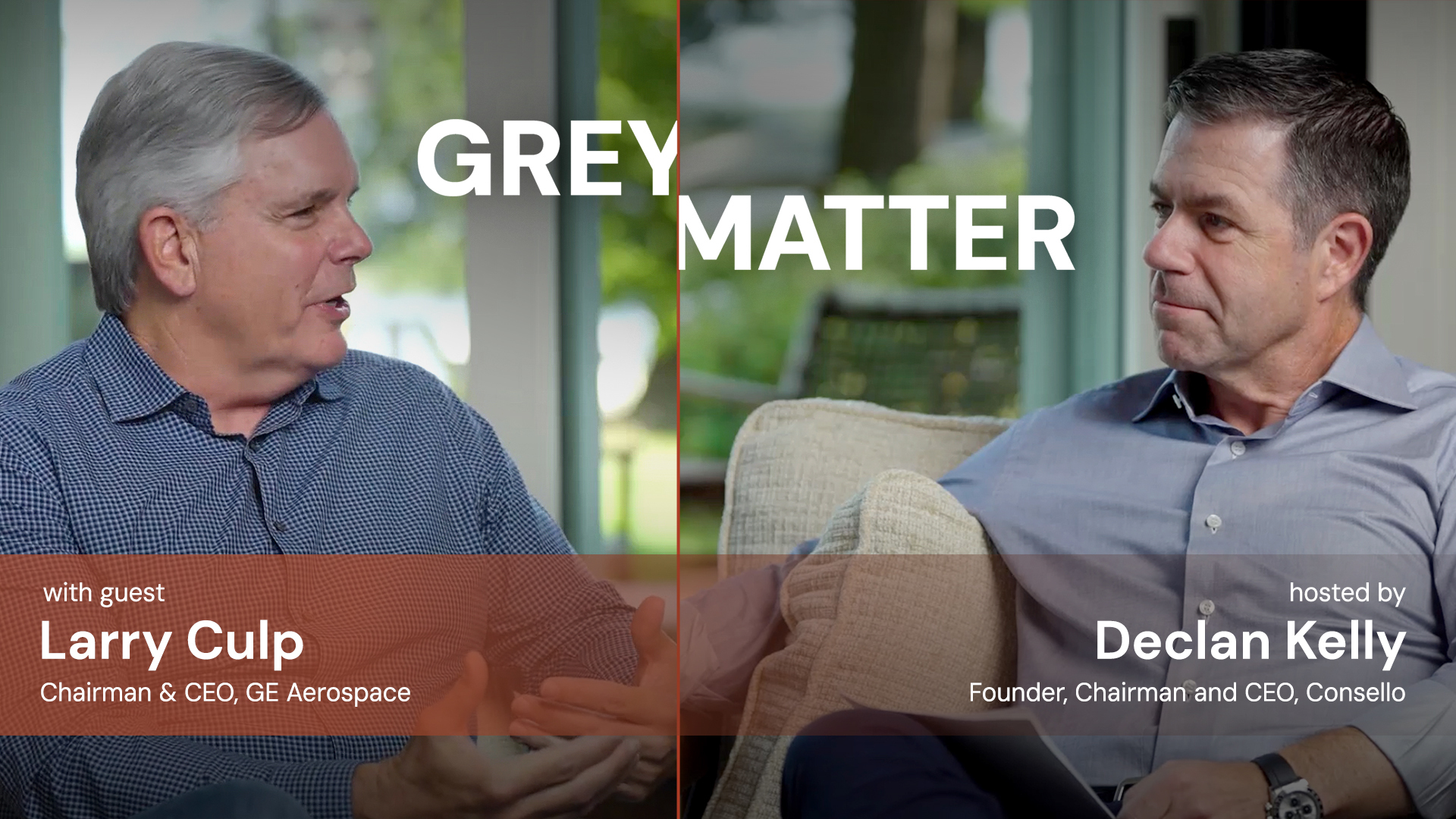
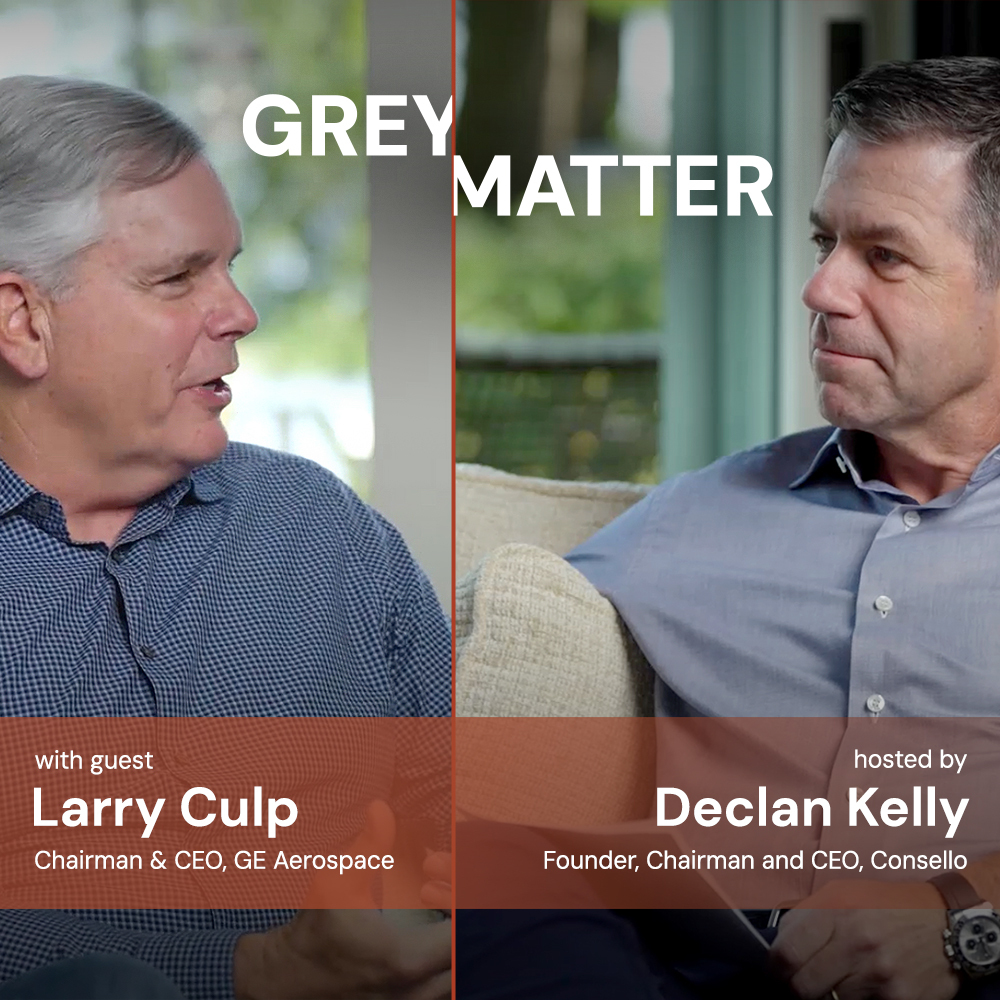
When Larry Culp became Chairman and CEO of General Electric in October 2018, the company’s debt exceeded $140 billion and the organizational complexity that had accumulated over decades now functioned as a constraint rather than a capability.
With rating agencies monitoring every move and confidence in the company’s future eroding, every choice mattered for the hundreds of thousands of employees, customers, and partners who depended on what came next.
Larry’s understanding of that kind of responsibility began in his grandfather’s welding shop in Maryland. Founded in 1938, it was a modest operation where consequences appeared immediately in whether payroll could be met. Larry still has his grandfather’s payroll register, viewing it as a reminder of obligation rather than sentiment.
“When you read the names in that payroll register, you know that these were individuals who had families whose weekly paycheck was really critical to their wellbeing,” he said.
That early exposure shaped how he later approached leadership at scale. At GE, Larry applied a discipline formed in conditions where focus emerged from necessity. The restructuring that eventually separated GE into three independent companies—GE Aerospace, GE HealthCare, and GE Vernova—restored the conditions under which judgment could function and decisions could be attributed to specific actions.
What followed was driven by principles tested across decades but proved most consequential when applied to an organization many had written off as unsalvageable.
Focus Over Synergy
The conviction Larry brought to GE had been forming throughout his career at Danaher, where decentralization and business-level accountability had driven performance across a portfolio that grew from $4 billion to $30 billion during his tenure. It centered on what happens when coordination costs exceed the value they generate.
“I’d gladly forgo the mirage of synergy for the tangible benefits of focus,” he told a group early in his tenure.
The statement landed hard enough that he recalls two people in the back of the room visibly reacting. Synergy had become embedded in GE’s organizational logic, serving as justification for maintaining connections across businesses that served different customers and operated in different cycles.
However, as the organization became more interconnected, execution increasingly relied on negotiation across boundaries that few fully owned. Decisions slowed as accountability dispersed, and attention shifted inward toward managing interfaces rather than outward toward serving customers.
Larry’s focus on dismantling this structure addressed a fundamental problem in how large organizations allocate attention. Interdependence creates surface area for decisions to be deferred and for accountability to be shared in ways that effectively dilute it. Reducing that interdependence forced each business to operate within the constraints of its own economics, its own customer relationships, and its own competitive position.
The lesson for organizations operating at scale centers on the relationship between structure and execution. When coordination costs begin to impair the ability to execute cleanly, focus restores the conditions under which judgment can function and accountability can hold.
Be Quick, But Don’t Hurry
When describing how he thinks about pace under pressure, Larry often returns to a quote associated with John Wooden, the former UCLA basketball coach.
“Be quick, but don’t hurry,” he said.
The early environment at GE carried a constant sense of urgency, with multiple issues competing for attention simultaneously.
“Everything looked like a crisis,” Larry said, recalling the early days of the role.
The environment created conditions where reactive decision-making could easily displace strategic judgment. Larry’s response centered on distinguishing between decisions based on their reversibility and their consequences. Choices that could be corrected carried lower risk and warranted faster movement. Decisions that would set direction or constrain future options required deliberation even when external pressure demanded speed.
“Sometimes a B or C decision doesn’t need a lot of analysis, and you can be quick to it,” he said.
The distinction introduced hierarchy into chaos. Teams received direction to act decisively where flexibility existed, while leadership attention concentrated on choices that would shape the company’s trajectory over quarters and years. The approach prevented the organization from mistaking motion for progress, a trap that becomes particularly acute when every stakeholder interprets inaction as weakness or indecision.
That separation of tempo by decision type became one of the mechanisms through which GE regained the ability to act decisively when both time and margin for error had nearly run out.
Leading from the Ground
For Larry, stewarding a complex organization consistently means remaining close enough to the work to see it as it is rather than as it is reported. In large systems, he found that filtered reporting and curated narratives tend to replace observation with interpretation, particularly under pressure, when incentives quietly reshape how information moves.
“If you’re talking about those things at altitude, you’re unlikely to really have a good understanding,” he said.
The statement captures a structural problem that compounds as organizations scale. Employees closest to the work typically recognize emerging issues well before leadership becomes aware of them, but the mechanisms designed to surface that knowledge frequently filter out discomfort or risk. What reaches the executive level arrives clean, late, and stripped of the texture that would allow for accurate diagnosis.
“Employees know their company very well,” he said. “Sometimes information doesn’t travel particularly well. Bad news certainly doesn’t go.”
His method for addressing this problem centered on direct engagement with people doing the work and with customers. He describes his approach to learning new businesses and understanding operations as getting out to talk to people, ask questions, and listen, particularly to those who might not be within the vicinity of the boardroom. The practice aimed to compress the time between recognition and response while anchoring decisions in observed conditions rather than filtered summaries.
At GE, where the margin for error had effectively disappeared and time operated as a constraint on every decision, proximity to unfiltered information functioned as a necessity. The company’s scale and the pace of its challenges created constant demand for judgment about where direct intervention would matter and where existing teams could execute without escalation.
Maintaining access to ground-level reality clarified those distinctions in ways that relying on formal reporting structures could not.
Judgment as an Accumulated Asset
The capacity to operate under the conditions Larry inherited at GE was drawn directly from 25 years at Danaher, where he accumulated what he describes as “reps” – —repeated exposure to consequential decisions that carried real stakes. He held his first P&L responsibility at 30, an unusually early assignment that compressed his learning curve and built familiarity with decision-making under uncertainty.
“You don’t learn judgment in a classroom,” he said. “You learn it by making decisions, living with the outcome, and doing it again.”
The observation points to how judgment develops differently from technical knowledge. Exposure without actual responsibility produces confidence without calibration. Responsibility without sufficient repetition produces caution without fluency. What shifts over time is the accumulation of decisions made and patterns recognized across enough cycles that responses begin to operate at an instinctive level.
Larry spent 14 years as CEO of Danaher before arriving at GE, running a portfolio of businesses and navigating complexity that created direct parallels to the challenges ahead. That experience allowed him to recognize patterns in how organizations behave under stress, how markets respond to uncertainty, and how teams execute when conditions deteriorate.
At GE, where many wrote the company off as unsalvageable and rating agencies monitored every financial move, Larry’s accumulated experience allowed him to distinguish between genuine threats that demanded immediate action and external criticism that could be absorbed without altering course.
Judgment functioned as an asset that had been built elsewhere and could not have been developed in the moment.
You Get Better or Worse, Never the Same
Early in his career at Danaher, Larry was introduced to continuous improvement through Japanese practitioners trained in the Toyota Production System, brought to the United States to teach what would become known as lean manufacturing.
“You either get better, or you get worse,” he said. “But you don’t stay the same.”
The statement originated with a junior high school basketball coach, but it found operational expression through kaizen, the method of continuous improvement that became central to how Danaher operated and later to how he approached GE. Kaizen functions through incremental changes to daily work, sustained by measurement and repetition that make progress visible and allow teams to distinguish real gains from activity that produces motion without improvement.
Larry was mentored by Katahiro-san, a kaizen sensei who had trained directly with Taiichi Ohno at Toyota and who became one of the first people Larry called when he arrived at GE. The relationship extended across decades, with Katahiro-san continuing to work with GE Aerospace leadership, hosting factory tours in Japan designed to raise expectations about what operational excellence actually requires.
At GE, where structural changes received public attention, durability depended on whether continuous improvement could function as an operating habit that outlasted the urgency of crisis. The method provided a mechanism for ensuring that gains held without constant executive intervention, allowing teams to tighten processes and clarify accountability through repeated examination of how work actually flowed through the organization.
That discipline determined whether the simplified structure Larry created would maintain its clarity or gradually accumulate the complexity that had impaired the company’s performance in the first place.
What Lies Ahead
Larry describes his approach as something shaped across decades rather than invented for the crisis at GE. The restructuring into three independent companies created the conditions for focused execution, but organizations drift toward complexity in the absence of countervailing pressure. Coordination begins to seem valuable again, accountability disperses across new interfaces, and the clarity that appeared obvious during crisis becomes subject to negotiation. The patterns that accumulate complexity operate slowly enough to feel rational in the moment, which is precisely what makes them difficult to resist.
At GE, the separation clarified what each business controlled and what it was accountable for delivering. The question now is whether focus, tempo discipline, proximity to operations, accumulated judgment, and continuous improvement can function as enduring operating principles rather than tools deployed under duress.
Structure creates opportunity, but focused execution determines whether that opportunity translates into sustained performance. What remains after the restructuring is not a fixed arrangement but a tested capacity to act decisively when complexity and consequence converge, built through disciplines applied consistently enough to become instinctive.